
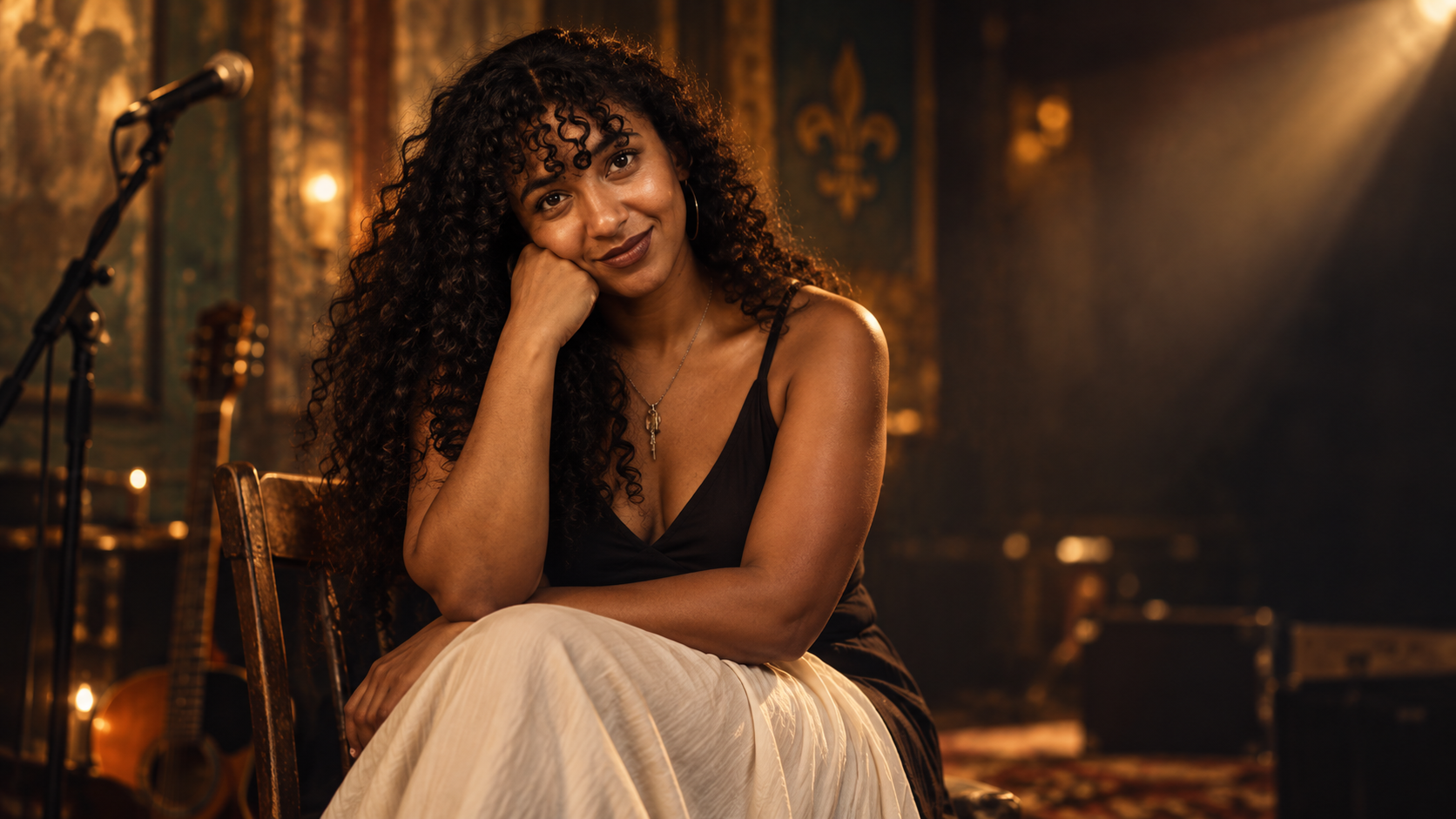
Sabine McCalla hears American roots music as a conversation carried across oceans. Raised in New Jersey by Haitian parents, she grew up with Haitian folk music, Motown, Bob Marley, the Beatles and girl-group records while studying classical violin from childhood. Later came Evergreen State College, immersion in New Orleans music, and studies in old-time fiddle and ballad singing in North Carolina. Her education became less about genre than about tracing the routes songs take between people and places.
New Orleans gave that curiosity a home. McCalla arrived roughly a decade ago, joining a community where songs were traded in houses, bars and backyards. She became fascinated by Irma Thomas, King Oliver, Howlin' Wolf and Lonnie Johnson, but also by the city's Caribbean inheritance. She has described Haitian and New Orleans music as cousins growing alongside one another, traditions that deserve far more exchange.
Her 2025 debut album, Don't Call Me Baby, makes that exchange audible. Co-produced with Sam Doores and Ajai Combelic, its nine songs move through early R&B, country, soul, folk, Brazilian rhythms and spirituals. "Sunshine Kisses" draws on samba while incorporating horns associated with Haitian Vodou ceremonies and harmonies influenced by the Haitian band RAM. "Deep River," the African American spiritual, brings McCalla together with her sister Leyla. Eli "Paperboy" Reed and The Lostines are among the record's wider musical family.
McCalla's fascination with Alan Lomax recordings and Harry Smith's Anthology of American Folk Music gives the work additional depth. She approaches roots music as living cultural memory, shaped by Black musicians, migration, communal singing and constant reinterpretation.
That makes tonight's AMERICANAFEST appearance especially fitting. McCalla performs at 8 p.m. at 3rd & Lindsley in Nashville, carrying Haiti, New Jersey and New Orleans onto one of Americana's most visible stages. Her music suggests that Americana's family tree is considerably larger than its familiar map.